
The Horse’s Advocate › Forums › Systems And Diseases › Talk to me about PSSM
-
Talk to me about PSSM
Posted by KarenM on March 10, 2021 at 1:07 pmLast fall my vet suggested PSSM (some variant of type 2) may be the source of Rem’s “issues”. (e.g. Repeated colic symptoms, reluctance to go forward, irritability, among others.) She suggested it again a month ago. Naturally there aren’t a ton of resources for the horse owner. She pointed me to Michigan State’s site, and I’ve found similar info from Minnesota (U of M) and UC-Davis. All of them seem to say they don’t know much about Type 2. One university is or will be doing a research study. Testing isn’t reliable yet. Are there other resources?
All point to diet, limited confinement, and controlled exercise as the keys to management–which seems like a prescription for any horse. I’m nearing 2 years of not feeding grain, kept Rem out as much as possible when I was able to control the environment, and just moved him last week to a farm where he isn’t stalled, and there’s a basic exercise plan. My vet also said to add vitamin E and magnesium, based on the Michigan State suggestions. I reluctantly added both and she will pull blood when she comes out in a few weeks. Rem had another colic episode a couple of days ago, his first since September. His colics came with warmer weather last year (but we just moved so was it stress? I dunno), but so does a much friendlier attitude (seriously – he’s cranky from November to March.) He had intermittent lameness over the past few years (fine now)–all “symptoms” anecdotally reported to be possibly related to PSSM type 2. I kind of wonder if I’m being sold a bill of goods, although it would seem to explain some of the unexplainable things we see with him.
Doc-t replied 4 years, 7 months ago 4 Members · 7 Replies -
7 Replies
-

PSSM is the acronym for PolySaccharide Storage Myopathy. EPSM and EPSSM are equivalents. The issue in this disease is the muscle cells are unable to utilize the glycogen well for energy production.
Glycogen is the way glucose (the basic sugar molecule of life) is stored in animals. Starch is how glucose is stored in plants. It is documented that some breeds of horses may develop an inability to convert glycogen into glucose for use in the mitochondria for fuel. A genetic change is given as the reason so that enzymes needed for this process to occur are altered or missing.
In my opinion, epigenetics (something that triggers a change in the genes) is at the root of many illnesses including cancer. It has been said that you and I have all the genes needed to develop any cancer out there, but it is the triggers that have not been pulled yet that prevents us from getting that cancer. Likewise, all epigenetic changes are brought on by triggers such as chronic stress, environmental chemicals, lack of sleep and poor nutrition. I’m sure there are more.
An example of this is celiac disease where a person becomes intolerant of wheat gluten. Until the trigger is activated, gluten is OK but once activated, the genetic change prevents the person from using gluten properly with adverse results occurring. I think this may be true with PSSM which means this can only be something that is managed and not cured.
But is this true? Or is there a better way to manage PSSM? Everyone agrees that glucose intake needs to be reduced and that a high fat diet needs to be fed. To understand this an understanding of glucose and fat metabolism is needed – so please listen to last month’s “Rounds” Aerobic exercise and the effects on insulin resistance.
Exercise will increase cell uptake of glucose for burning (assuming that glycogen is prevented from being converted into glucose). It will also cause increased production of triacylglycerides (TAG) for conversion into free fatty acids (FFA) for use as fuel. Adding fat to the diet will also increase production of TAG with more FFA’s entering the cell. Adding to this a severe decrease in glucose (starch) in the diet will actually start insulin resistance (IR) as the body preserves glucose for the brain. From this state, the horse will start gluconeogenesis (GNG) and convert other substrates including amino acids into glucose. Over time the horse will actually become less healthy even though the muscles have been trained to use more fat and less sugar.
Is your brain twisted yet?
I introduced the concept of mitochondrial flexibility which is now being looked at in humans as the most positive health change our cells can do. In humans, this flexibility occurs during periods of fasting where there is NO SUGAR or any other nutrient brought into the body thus eliminating most causes of inflammation. In less than 24 hours the cells are forced into using fat for fuel and the body fat is lost for conversion into this fuel. In addition, any glycogen is forced into being consumed. And there is more. “Bad” and broken proteins are consumed, unhealthy mitochondria and cells are replaced and free radicals that cause inflammation are removed. In fact ALL causes of inflammation expressed in the gut (colic), joints (stiff joints) lungs and brain are removed. Fasting not only makes you feel better, it IS better.
But this is in humans and not in continuously grazing horses. But what about winter? There was no hay so the horses actually fasted on cellulose with little starch. Then as spring came, the attitude improved and body fat increased. This is the essence of mitochondrial flexibility. Part of the year without glucose and part of the year with glucose.
I wonder what Rem would be like with some version of introducing flexibility? Restricting food intake frightens people but what if we soaked the hay to remove all glucose for a week along with no pasture and then reversed this with a sort period of pasture and hay? Could we force him to consume his glycogen and then replace it?
My problem with the protocol for PSSM (decreased starch, added dietary fat, added exercise) is it forces the horse to only use TAG / FFA’a for fuel which is not the flexibility he needs. This then becomes a trigger for increased IR due to the increase in TAG in the cell being converted into DAG (diacylglycerides). Yes, IR in a horse who is NOT fat. The increase in fat used for fuel also increases Acetyl CoA which triggers more conversion of body substrates (amino acids and others) into glucose through GNG. Now the horse is creating more glucose to feed the brain. But it is also available for muscle and liver glycogen without the need for insulin to enter the muscle cells. This does NOT force the use of glycogen which is the problem with PSSM horses.
Rotating through periods of lack and abundance may be what is needed for these cells to 1) repair or replace themselves and 2) activate the consumption of glycogen.
As most here know, I am confident that all horses are protein deficient. There is no way to measure this other than to see the loss of top line or see the poor hoof and hair quality. Remember that all enzymes and all cellular processes are driven by proteins. You say Rem has been off grain for 2 years, but what about the addition of high quality protein in SBM (soybean meal)? Have you been adding this too? If not, is it possible that he is also protein deficient? In the PSSM protocols there is no mention of replacing any lost amino acids. In may assessment, the high fat diet will lead to more protein loss and a further demise of the horse.
As you may already know, I think outside the box. My belief is that we need to get back to the basics and get things right first. That is, to remove all causes of inflammation and then replace the lost amino acids. Once this is achieved, the horse will have a chance to repair and have a health span we all want for our horses. However remember that when a horse is insulin resistant and with glucose intake low, protein can often be converted into glucose through GNG before they are used for repair. You need to be diligent in your observations. PSSM horses are usually not IR but restricting their glucose intake and increasing their fat intake may trigger conversion of SBM into sugar. If you add SBM with no other changes and he gains body fat then this is exactly what is happening. If so then decreases the added dietary fat and increase the work to force the cells to work as they should. Then give the cells some rest to repair using the SBM. Alternate this to create flexibility.
I have no exact plan for you other than to experiment. No one has looked at mitochondrial flexibility in horses. Use his moods as well as his lack of colic and stiffness to help you understanding his metabolic dynamics. Maintain accurate records so you can report back here with details. No vet or equine nutritionist is talking about mitochondria flexibility (going back and forth between fuels) but it is how all animals have lived before food was abundant 24/7/365. As I said, let’s get back to square one and build from there.
Anyone have other thoughts?
Also see the nutrition blogs on Hormesis and mitochondrial exhaustion – or complete the nutrition course included with your membership.
-
-
-

Ah, an update–of course!
Recap: a variant of PSSM-2 is/was suspected. Added Vitamin E and Magnesium Oxide per vet’s basic recommendation. Rem gets 7 grams of natural Vitamin E and 29 grams of magnesium oxide. Made no other dietary changes. He has improved. Oh – I originally had his Vitamin E checked last fall. The vet tested in-house. I was told it was too low, they ran it again then I was told it was okay. I don’t recall the numbers offhand.
Moved Rem to a new farm March 1 where he is not confined to a closed up stall at all, but is in a large private paddock and shelter for part of the day. Spring check up was 4/8. Blood drawn for Vitamin E and Mg levels and sent to Cornell for testing. Results were “perfectly normal” (that’s with the addition of the two to his diet; question about that in a bit). Vet didn’t give me the numbers. Also did a fecal (dewormed 4 weeks prior with moxidectin) and for the first time ever, the sample was negative. His fecal test results are always anywhere from 500 to 1200 regardless of when tested. Seems unlikely that this time we just happened to collect an empty sample. Where does that fit in the puzzle, or does it?
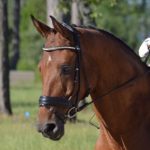
I have never seen this horse so comfortable. He has always hated, I mean hated, to be groomed. I had to keep one eye on his expression and avoid his teeth. Now he takes naps and he has become more consistently happy all around. Even though he typically relaxes more in warmer weather, this is different. He walks like he’s actually going somewhere other than the gallows. Our coach hopped on him (pic) and he went along casually without a lot of urging (he typically gets nervous with anyone else.) Before he would not go more than about 20 strides without coming to a full stop and refusing to move, then he walked back to the barn very slowly, but he never “tied up”. All to say we don’t know if he has PSSM because we can’t test for it yet but he seems better after being treated as if he does.
Here’s my question (posed to my vet but she hasn’t answered me yet): if blood levels are “perfectly normal” WITH supplementation, does that mean he definitely needed it? If I cease giving it will his levels drop? Did the negative result in the fecal sample play a role in his comfort? Is it just that he has the freedom to move whenever he wants? All of the above? Am I seeing things that aren’t there?
I haven’t read if supplementation should be seasonal. I’m tempted to forego the Vitamin E since the grass is coming in but it isn’t lush grass (mostly Bermuda; don’t know what else other than the ubiquitous clover), and he still gets hay in his paddock where there isn’t much grass. I also don’t want a replay of “Dark Remy”. With normal blood levels now, it seems the only thing negatively affected is my wallet when I have to reorder. Vitamin E isn’t cheap but a little goes a long way (the Mg is very cheap). Also, he has been rip-snorting around in a way I’ve never seen. Major bucks and zoomies that are quite terrifying to watch in a horse that has a history of injury.
Trying supplementation appeared to be successful in Remy’s case, and I’m certainly not advocating for anyone to give it a go without vet advice. I was skeptical. The downside for me is that now I question *everything*. Do I need a full blood panel to be sure I’m not mucking up the rest of the machinery? Should I have tested selenium as well, or is there something else that will rear its head since all of this stuff is connected? It’s been some weird game of Jenga with this horse for the past few years but for now he is in pretty good shape.

-
-
-
I am SO happy to hear that Remi is feeling so much better!! I look forward to reading any comments Doc T has to your questions. I hope you’ve cracked the code for this horse.
-
Here’s my question (posed to my vet but she hasn’t answered me yet): if blood levels are “perfectly normal” WITH supplementation, does that mean he definitely needed it? If I cease giving it will his levels drop? Did the negative result in the fecal sample play a role in his comfort? Is it just that he has the freedom to move whenever he wants? All of the above? Am I seeing things that aren’t there?
This is a fascinating report that raises more questions because you did two big things: 1) added vitamin E and Mg and 2) moved to where he gets free exercise. Now you have normal Vit E levels and his attitude is great. In addition you have not reported any signs of tying up or other signs of PSSM. It is logical to wonder if you want to stop supplementing because you don’t know really what has cured him – the supplement or the exercise.
If my hypothesis is correct about mitochondrial flexibility then it is the “rip-snorting” exercise that has improved the glycogen storage. But could it be the addition of the supplements that allowed him to do this? Or is it the new pasture, new water source or just the freedom from the stall that allowed it? The only way to answer this is to change something and look at the results. Either stop the supplementation or stop the ability to have free exercise.
We are learning a lot about Vit E and currently it is believed to be an overconsumption in certain breeds (Morgans) requiring supplementation. This doesn’t fit your horse.
Mg deficiency is the essence behind several theories in human health but I have not seen this in horses other than in those fed grain with dicalcium phosphate added. Mg does have a calming effect that you are seeing in Rem.
I really have no advice to give here nor does your vet. Rem is where you want him with what you have done. It will be through experimentation to determine what you need to alter while keeping him happy. If you decide to change supplements then only do one thing at a time and wait a week or two.
You still have other options including time restricted feeding of hay, reducing overall starch consumption via reduction in amount of hay or soaking hay in water and the addition of a high quality protein source such as soybean meal. All of these would improve the cellular health both in glycogen use and the production of the enzymes needed for this.

Log in to reply.