The Horse's Advocate Community Area

Find answers, ask questions, and connect with our
community around the world.

The Horse’s Advocate Forums Horse Care, Barn & Farm Topics Exercises for building the topline

  • Exercises for building the topline

    Posted by DinahC on January 4, 2022 at 4:24 pm

    In answer to your question re building topline @AngelaM, I believe there are 2 “tools” needed in order for topline to develop naturally so that they remain, even when the horse is not in work.

    The first is the adequate intake of high quality protein as only protein makes muscle. (I see Doc T has reminded us of that in the Barn Gate thread). The second is a horse that is posturally (not sure if that is really a word! :D) correct with muscles that are not tight, restricted and contracted.

    My preference and recommendation
    for back muscle building exercises
    is in-hand walks, with hill work, if that’s possible. Include agility exercises while out walking, such as stepping over logs, up and down little banks or pavements, include a circle here and there of various sizes, include different going i.e thicker sand, heavier going esp as your horse gets fitter. The more variety of activities the better. This can be done on a simple lead rein but if you want to speed up the process and your horse can comfortably work into a contact, then walk on the long line and that will add a little tension which helps engage the abdominals and thus the back. But if your horse cannot comfortably stretch over his back and instead just hollows his back and neck and tucks in his head, then you would do better to walk on the lead and get help to release the fascia before embarking on anything more demanding.

    I would only start ridden work once you have ensured the back muscles are fairly free of tension, the horse can comfortably lower his head and neck of his own accord while walking, the muscle has built up to about 80% of ideal and of course your saddle and saddle pad is fitting correctly and allows your horse to carry you in correct balance.

    My test to assess tension in the back is to use my thumb nail and run it in short vertical lines, starting in the wither pockets /shoulder holes and continue to at least the SI. Each draw runs between the dorsal spinal processes (DSP) and the rib heads. Any flinching, tightening, dipping or collapsing of the back or reaction from the horse indicates tension and I would consider very carefully putting a saddle on the horse.

    I do not recommend exercises where the horse is asked to stretch this way and that way (with or without carrots!) and repeatedly walk/trot over poles etc especially if the back muscle is not building because the fascia is tight. In cases like this, I just see horses working a plan to get the exercise done to please the owner and get their treat. As soon as the work stops, maybe a short holiday or time off due to injury, the muscle immediately wastes as the tight fascia dominates again

    Tension free fascia allows good blood circulation and healthy nerve function and if this can be achieved, then your horse can build and maintain the muscle in his topline just by walking around the field!

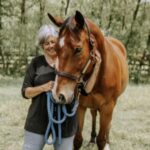
    The photo is of my horse. She has not been in consistent work for more than 2 years and for the last 9 months any work has been principally in walk and most has been in-hand walking. The reason she’s been out of work is largely due to her diet that really affected her very badly and also due to a nasty horsebox/trailer accident (April 2021) which caused her huge soft tissue pain and discomfort. She had just turned 14.

    AngelaM replied 3 years, 9 months ago 4 Members · 5 Replies
  • 5 Replies
  • AngelaM

    Member
    January 4, 2022 at 9:26 pm

    Thank you Dinah-I think I am on the right track then-I use the dirt bike jumps that my husband made for little hills. And we hand walk over different surfaces-I should add the ground poles though. It will be 5 months with the diet before I try riding again (just based on winter here) so I am very interested to see how that goes-of course gradually building fitness.

    • KarenM

      Member
      January 6, 2022 at 12:52 pm

      @AngelaM , two great resources that support the advice you’ve received are two books by Jec Ballou: “Equine Fitness” and “55 Corrective Exercises for Horses”. There are diagrams and photos as well as full descriptions of targeted exercises. I’ve found both very useful.

  • DinahC

    Member
    January 5, 2022 at 10:17 pm

    @AngelaM…. Sounds like you have the ultimate agility track made for you ;). Look forward to hearing your progress and seeing some photos.

  • Doc-t

    Administrator
    January 6, 2022 at 10:41 pm

    Thanks for this @DinahC – I did laugh as I realized that “diet and exercise” is still the solution. It is interesting that the exercise portion of this equation is filled with various techniques that often are either unproductive or very productive depending on the trainer, practitioner, owner and horse. In this case, if you are a Tom Brady football fan you will believe in muscle tension release (the TB12 method). Tribalism occurs around ideas and theories of training (in any sport like football or horses) but in my opinion, it is ANY LACK of exercise (sedentary) that is the worst. This includes temporary removal of exercise. With many horses confined to a stall most of the day, a sedentary lifestyle is their definition of existence. Even fat and lazy brood mares can be seen running about and this time outdoors out of the 12×12 box stall is so essential for muscle development and maintenance – as long as the diet (high grain / low protein) isn’t sabotaging these efforts.

    Where I believe a structured exercise program with tension reduction is needed is for horses with musculoskeletal issues that diet alone will not help. For example, exercise will help with post injuries, with kissing spine, with strained connective tissue (tendons and ligaments), with joint instability and yes, with replacing the top line. However for the sedentary overweight horse, diet plus movement is the solution. But often this will take a year or more. Maybe with a focused exercise / training program like you suggest, the time to a returned top line may be shortened. It would be fun to test this though it is logical that it would.

  • AngelaM

    Member
    February 9, 2022 at 5:36 pm

    So we’ve been doing ground poles in various configurations. Sometimes using snow banks as risers for my mustang cross. Hills, backing up etc. I was carefully making sure the ground poles were flat (not on snow banks) for the standie due to the OCD in the hocks. Well, the other day they started goofing around as geldings do. The standie was demonstrating how he has perfected rearing, bucking and galloping without tipping over (still doesn’t look what I would call magical) and at one point he cleared a 4 foot snow bank with zero faults-almost from a stand still and on an angle. So he is definitely feeling good. Or at least he was until that point (I do think he strained something in his pelvis but good Lord, how could he not?).

Log in to reply.